Teacher selects the topic and presents the scenario:
Pendulum clocks sometimes lose time and sometimes gain time. They also have bobs of different materials and shapes. We also find that the amplitude of the oscillations differ from one another. We need to understand how they maintain the same time and if they differ what are the possible reasons and the corrections required to be taken by the clock industry.
Teacher presents the scenario and makes the students understand the basic principles behind the concept.
Teacher presents the scenario and encourages the students to investigate and understand the working of a pendulum clock, establish relationship between the various parameters and find solution to the stated problem.
Teacher presents the scenario and encourages the students to find solution to the problem the clock industry faces.
Teacher states the question for the students to undertake investigation -
"How will you determine whether the losing / gaining of time by the pendulum clock depends on the length of a simple pendulum, the material, shape and size of the bob and its amplitude?"
In order to help in the investigation, the concept of a simple pendulum needs to be understood. The teacher explains the concepts.
- What is a simple pendulum?
- How does a pendulum clock work?
- Why do clocks lose / gain time?
- What is meant by length, bob, oscillation, period and amplitude of a simple pendulum?
- What is the relationship between the period and size,amplitude, material and shape of the bob?
Teacher states the question for the students to undertake investigation -
"How will you determine whether the losing / gaining of time by the pendulum clock depends on the length of a simple pendulum, the material, shape and size of the bob and its amplitude?"
In order to help in the investigation, the concept of a simple pendulum needs to be understood. The teacher explains the concepts.
- What is a simple pendulum?
- How does a pendulum clock work?
- Why do clocks lose / gain time?
- What is meant by length, bob, oscillation, period and amplitude of a simple pendulum?
- What is the relationship between the period and size,amplitude, material and shape of the bob?
Students decide on the questions to be generated to understand the principles of a pendulum clock. (Details are covered under Student Notes)
Background work is done by the teacher before designing the investigation.
Background work is done by the teacher before designing the investigation.
Background work is done by the teacher before designing the investigation.
Teacher discusses with students the possible hypotheses and the students verify after carrying out the investigation as instructed by the teacher.
Students write about the anticipated results before the experiment is conducted.
- If the period of a pendulum is related to the length of the pendulum, then the increase in length of the pendulum will have a direct relation with the square root of its length.
- If the period of the pendulum is related to the material of the bob, then increase in density of the material must result in decrease in the period of the pendulum
- If the period of a pendulum is related to the size of the bob, then increase in size of the bob must result in decreasing the period of the pendulum
- If the period of a pendulum is related to the shape of the bob, then changing the shape of the bob must result in changing the period of the pendulum.
- If the period of a pendulum is related to the amplitude, then increase in amplitude must result in increasing the period of the pendulum.
Students write the hypotheses related to the question they are trying to answer. Needs to be verified after the experiment is conducted ( Details are covered under Student Notes)
Students write the hypotheses related to the question they are trying to answer. Needs to be verified after the experiment is conducted ( Details are covered under Student Notes)
Teacher designs the investigation and provides the materials for the students to conduct the investigation.
In this investigation students will determine the
dependence of the period of a simple pendulum on length, the material and size of the bob and its amplitude. The method of measuring the time required for fixed number
of oscillations to calculate the period of the pendulum is used.
Students design the investigation based on the materials provided by the teacher (Details are covered under Student Notes)
Students choose the materials and design the
investigation.(Details are covered under Student Notes)
While the students cannot be restricted on what or how he
chooses to investigate, they must be provided a
framework on the sections that their investigation must
cover. i.e. his inquiry must have a Hypothesis, must
incorporate research, must have a clearly deigned
procedure, including a representative diagram of the setup
using properly chosen materials; they must record their
data and observations, tabulate the results and analyze
them graphically where possible. The results must be
presented only after careful study. A sample of the
investigation to be made is mentioned below. However, it
could be different based on their innovative approach.
All the steps for the procedure are written without any
ambiguity by the teacher and the students follow the
procedure exactly as written. Methodology is given below:
- With the help of a Vernier Caliper, measure the diameter of a steel bob
- Tie an inextensible string to the bob so that the length of the string, from the centre of the point of suspension to the centre of the bob, is slightly over 100 cm.
- Pass the string through the split cork clamped to the stand and adjust the string so that the length of the string from the base of the split cork is exactly 100 cm from the centre of the bob.
- Take the string to one extreme position and measure the angle through which it has been turned with reference to its original vertical position, with the help of a protractor and a plumb line – as shown in the diagram.
- Simultaneous to releasing the pendulum, start a stop clock. Measure the time taken for 20 oscillations (to and fro motion) with the help of the stop clock. Repeat the measurement 3 times so that an average time can be recorded to take care of errors in measurements.
- Repeat the experiment by varying the length of the pendulum
- Repeat the experiment by changing the bob to brass and aluminium bobs but keeping the size of the bob and length of the pendulum same.
- Repeat the experiment by changing the size of the bob only but keeping all other parameters same.
- Repeat the experiment by changing the amplitude only but keeping all other parameters same.
The entire stepwise procedure without any ambiguity is drawn by the students The student need not draw up the procedure as per the teacher's expectation. An alternative procedure that is equally viable may also be possible. (Details will be covered under Student Notes)
The entire stepwise procedure without any ambiguity is drawn by the students The student need not draw up the procedure as per the teacher's expectation. An alternative procedure that is equally viable may also be possible. (Details will be covered under Student Notes)
Teacher lists and arranges the material required for the
experiment on Simple Pendulum:
- An inextensible thread (Twine thread) – About 2 meters.
- Metallic bobs of different sizes and materials with hooks
- Steel bob 25 mm diameter -1 No.
- Steel cube 25 mm – 1 No.
- Iron bob 25 mm diameter -1 No.
- Brass bob 25mm diameter, 13 mm diameter and 19 mm diameter – 1 No. each
- Aluminium bob- 1 No. each
- Clamp stand, Vernier Calipers, Stop clock, Split cork, Graph papers( Normal cm graphs and logarithmic graphs) , A protractor, Meter scale and A pair of scissors
Teacher lists and arranges the material required for the
experiment on Simple Pendulum:
- An inextensible thread (Twine thread) – About 2 meters.
- Metallic bobs of different sizes and materials with hooks
- Steel bob 25 mm diameter -1 No.
- Steel cube 25 mm – 1 No.
- Iron bob 25 mm diameter -1 No.
- Brass bob 25mm diameter, 13 mm diameter and 19 mm diameter – 1 No. each
- Aluminium bob- 1 No. each
- Clamp stand, Vernier Calipers, Stop clock, Split cork, Graph papers( Normal cm graphs and logarithmic graphs) , A protractor, Meter scale and A pair of scissors
Students list the materials required based on his design of the investigation and arranges the material required for the experiment in the laboratory by coordinating with the teacher in charge. Materials may be entirely different based on students' design or may remain the same.( Details are covered under student notes)
Teacher provides the Drawing/Sketch for the experimental set up.
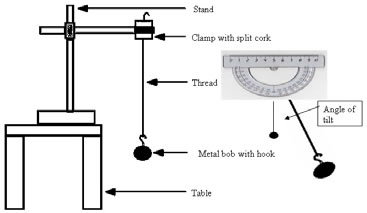
Students make a drawing/sketch of the experimental set up based on his design. It may be entirely different or even remain same as the one provided above.
Students make a drawing/sketch of the experimental set up based on their design. It may be entirely different based on innovativeness of the students or even remain same as the one provided by the teacher in structured inquiry.
The teacher guides the students to observe and collect the
data by giving clear instructions
States what observations are to be done and what data is
to be collected;
Outlines the method of tabulating the data
Explains what graph is to be plotted.
The data observed is recorded in Table-1, Table-2, Table-3
and Table-4 :
OBSERVATIONS
Table-1 Steel bob diameter 25 mm Amplitude:
Corresponding to 60 degree from the mean position of the
string
| Length of the pendulum (cm) | 100 cm | 80 cm | 60 cm |
| Time taken for 20 oscillations (seconds) | |||
| Period of the Pendulum (seconds) |
Table-2 Length of the pendulum: 80 cm Amplitude: Corresponding to 60 degree
Diameter of the bob: 25 mm from the mean position of the string
| Material of the bob | Steel | Iron | Brass | Aluminium | Lead |
| Time taken for 20 oscillations (seconds) | |||||
| Period of the pendulum seconds) |
Table-3 Length of the pendulum: 80 cm Amplitude:
Corresponding to 60 degree
Material of the bob: Brass from the mean position of the string
| Size of the bob(mm) | 13 mm | 19 mm | 25 mm |
| Time taken for 20 oscillations (seconds) | |||
| Period of the Pendulum (seconds) |
Table-4 Length of the pendulum: 80 cm
Material of the bob: Brass Size of the bob: 25 mm.
| Amplitude (Corresponding to degree from mean position) | 30 | 45 | 50 | 55 | 60 |
| Time taken for 20 oscillations (seconds) | |||||
| Period of the pendulum seconds) |
Table-5
Steel cube 25 mm Steel ball 25 mm diameter Amplitude;
60 degree
Length of pendulum - 80 cm
| Shape of the bob | Cube | Sphere |
| Time taken for 20 oscillations (seconds) | ||
| Period of the Pendulum (seconds) |
Students decide the data to be observed, design the tabulation of data, do the necessary calculations and draw suitable graphs. (Details are covered under Student Notes). The teacher may guide as to what the expectations are. For example, the teacher may state that there needs to be a table and a graph.
As mentioned under guided inquiry, data observation, tabulation, calculation and graphs are drawn by students (Details are covered under Student Notes)
The student observes the data recorded and the graphs drawn, summarizes and concludes the relationship between the parameters studied in the experiment. They discuss in their conclusion whether their hypothesis was correct or not. Based on the experimental data observed and the graphs drawn, the conclusions are drawn by the students. The summary of the answers for the questions raised by the teacher for the investigation are recorded (Details are covered under Student Notes).
The students observe the data recorded and the graphs drawn, summarize and conclude the relationship between the parameters considered in this experiment. They discuss in their conclusion whether their hypothesis was correct or not. Based on the experimental data observed and the graph drawn, the conclusions are drawn by the students The summary of the answers for the questions raised by the teacher for the investigation are recorded (Details are covered under Student Notes).
The students observe the data recorded and the graphs drawn and conclude the relationship between the parameters considered in this experiment. They discuss in their conclusion whether their hypothesis was correct or not. Based on the experimental data observed and the graphs drawn, the conclusions are drawn by the students The summary of the answers for the questions raised for the investigation are recorded (Details are covered under Student Notes)